
DairyNZ research in action: mitigating heat stress

Supplied by DairyNZ
New DairyNZ research will help farmers mitigate the impacts of heat stress on herds in high-risk regions of the country.
DairyNZ scientists are in the final stages of an on-farm trial at DairyNZ’s Scott Farm in the Waikato to test common mitigation measures and assess their return on investment.
According to DairyNZ senior science manager Kirsty Verhoek, heat stress is an increasing challenge for pasture-based dairy systems, particularly in regions experiencing more frequent hot, radiant, and still conditions.
“Through previous research and farmer engagement, we have heard clearly that farmers want practical, evidence-based solutions to help protect cow welfare, maintain milk production, and support long-term farm resilience,” she says.
“However, many heat stress mitigation measures require investment and farmers have told us they need confidence that tools will work under New Zealand’s grazing conditions and deliver value on farm. This research programme has therefore been shaped alongside farmers, focusing on understanding where and when heat stress occurs, how cows respond, and which mitigation measures are both effective and practical within real farm systems.”
It is the latest piece of animal care research in DairyNZ’s ‘Comfortable Cows Outdoors’ project. To date, the three-year programme has mapped regions that are at higher risk of high temperatures, solar radiation, and wind; analysed datasets linking weather and milk yield; assessed how cows use shade; and completed a comprehensive survey of 350+ farmers in Waikato, Bay of Plenty, Canterbury and North Otago understanding awareness, attitudes and practices related to heat stress in dairy cows (recently published in the New Zealand Journal of Agricultural Research).
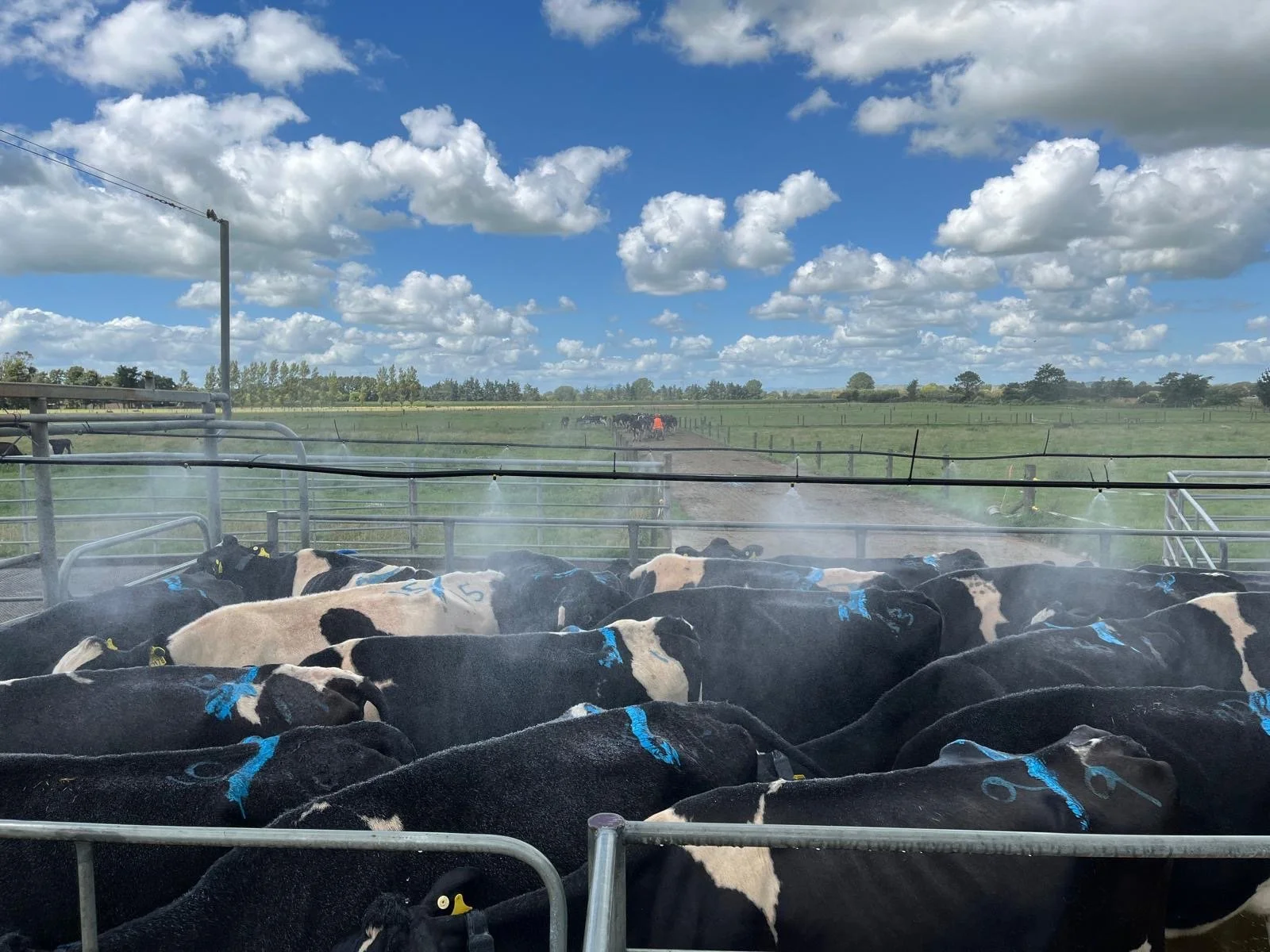
Scott Farm is in the final stages of a heat stress trial where five mobs of cows have been fitted with rumen temperature boluses, pedometers, and wearable technology all providing real-time data, to test the impact of various mitigation measures.
“We have a mob that’s gone once-a-day through the summer to avoid the afternoon walk to the milking shed, a second mob spending their daytime in a shaded area, a third mob that goes under misters in the yard cooling the environment around the cows while waiting for milking, a fourth mob that while waiting in the milking yard goes under a sprinkler where droplets saturate the coat (evaporative cooling); and a fifth (control) mob with no mitigations at all,” says DairyNZ scientist Charlotte Reed.
A group of Waikato farmers recently got to see the trial in action during a workshop at Scott Farm. Many of the farmers who attended have been actively involved in DairyNZ’s heat stress research to date and were able to share valuable feedback on the practicality and fit of different mitigations on farm.
“The workshop also provided an opportunity for farmers to see how their input has directly helped shape the research questions, trial design, and future direction of the programme, while getting an update on current progress. Our goal with testing this range of options is not to say, ‘this is what you should put in place’, but to provide information around a range of different strategies – a toolbox of options,” says Charlotte.
“A goal of the project is to better define how cows respond to heat load. With the volatile weather experienced this summer, we’ve ended up with a comprehensive dataset that spans from cooler, wet days all the way to hot sunny days, which is very valuable.”