This is day 4 of our seven-day series, The Future-Proof Dairy, where we explore the ideas, technology and changing approaches that could help shape the future of New Zealand dairy farming.
For generations, some of the most important decisions on a dairy farm have been made with the farmer's own eyes and experience.
A cow walking a little differently through the yard. A change in the way she stands. A quarter that does not look quite right. A cow that hangs back from the rest of the herd or simply does not seem herself.
Experienced dairy farmers develop an instinct for these things.
They know their cows, understand their routines and can often spot when something is not right long before a computer or spreadsheet would normally flag a problem.
But what if technology could provide another set of eyes?
What if a system could continuously monitor cow movement, behaviour and other patterns, picking up subtle changes that might otherwise go unnoticed until the next herd check?
That is where artificial intelligence, often referred to as AI, could begin changing the way animal health is monitored on dairy farms.
The goal is not to replace the farmer. It is to give the farmer more information, earlier.
Looking for the signs before they become obvious
One of the biggest challenges with animal health is that by the time a problem is clearly visible, it may already have been developing for some time. A cow does not suddenly become severely lame without something changing first.
Her stride may shorten slightly. She may begin walking more slowly. She may spend less time standing at the feed face or move differently through the yard. These changes can be subtle.
In a herd of several hundred cows, noticing every small change in every individual animal can be difficult, particularly during busy periods of the season.
This is where AI has potential.
Technology can collect information from cameras, sensors and other monitoring tools and look for patterns that may indicate a change in an individual cow's normal behaviour.
Instead of relying only on a single observation, the system can compare what a cow is doing today with what she has been doing over time.
If her movement begins to change, the system may identify that pattern and alert the farmer to take a closer look.
The same principle could apply to other health issues.
A change in activity, rumination, eating behaviour or milking patterns may provide an early indication that a cow is under pressure.
The technology does not diagnose the problem by itself. It highlights the possibility that something has changed.
The farmer, supported by their own observations and appropriate animal health advice, can then investigate further.
Artificial intelligence may not know a cow the way a good farmer does, but it may notice small changes before they become impossible to ignore.
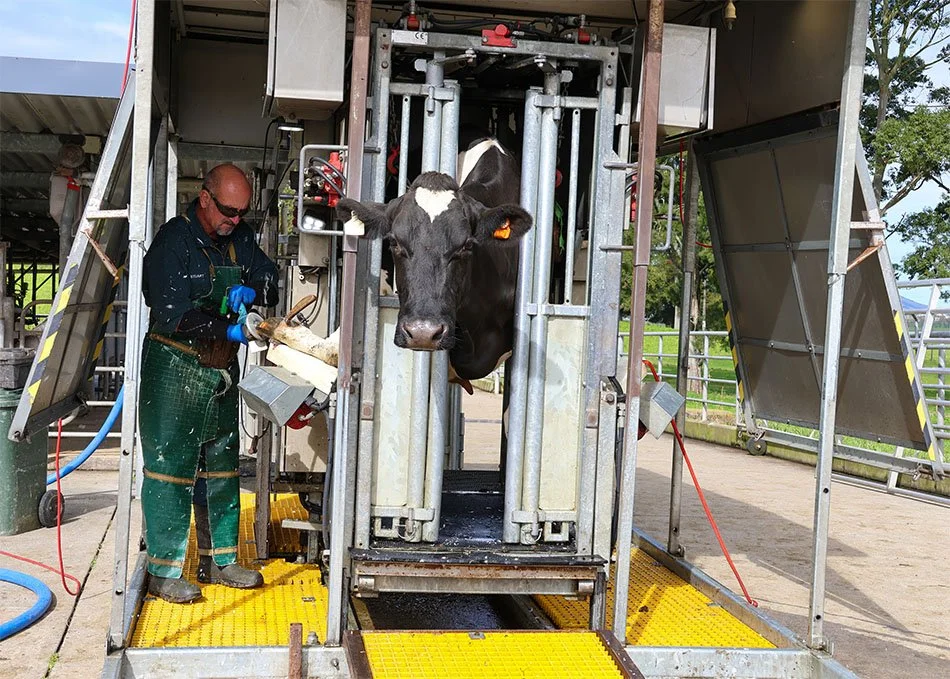
Photo by Dianna Malcolm
Could AI help with lameness?
Lameness remains one of the issues where earlier detection could make a significant difference.
A cow that is uncomfortable is unlikely to perform at her best.
Lameness can affect how far she is willing to walk, how confidently she moves, how long she spends grazing and how well she competes for feed. If the problem becomes more severe, it can have ongoing effects on production, fertility and overall animal wellbeing.
The difficulty is that mild lameness can be easy to miss.
A cow may look slightly uneven when walking out of the shed but appear normal when standing still. Another cow may be at the edge of the mob where she is harder to observe closely.
Over a busy season, subtle signs can be overlooked.
AI-supported movement monitoring could help identify changes in gait and mobility by analysing the way cows walk.
Rather than relying on one quick observation, the technology could monitor movement repeatedly and identify patterns that suggest a cow may need attention. This could allow farmers to investigate earlier.
Early action is often simpler than waiting until a problem becomes severe. Identifying a cow when she first begins to show signs of discomfort could provide an opportunity to assess the issue, make changes and prevent the problem from escalating.
It may also make it easier to monitor whether a cow is improving.
Rather than relying entirely on memory or occasional observations, ongoing information could help show whether her movement is returning to normal.
For farmers managing large herds, that additional level of monitoring could become particularly useful.
Finding changes that may point to mastitis
Mastitis is another area where earlier identification has the potential to support better decision-making.
Not every case begins with an obvious visual change.
A cow's behaviour or milking pattern may begin to alter before the signs are clearly visible to the farmer.
Changes in milk characteristics, yield patterns, activity or other measurements may provide clues that something is happening.
AI systems could analyse multiple pieces of information at the same time, looking for unusual patterns that may indicate a cow requires closer attention.
This is where artificial intelligence differs from simply collecting data.
Dairy farms already generate large amounts of information.
Milk production figures, activity records, mating information, animal treatments and other data can all be recorded. The challenge is finding useful patterns within that information without requiring someone to spend hours studying reports.
AI could potentially connect information that may otherwise sit separately.
A drop in production on its own might not raise concern. A small drop combined with a change in activity and a change in milking behaviour could provide a different picture.
The system may be able to identify those combined changes and flag the cow for inspection.
That does not mean the technology can guarantee a diagnosis.
It means it can help answer an important question sooner. Which cow should I look at first?
The value of an earlier warning
The greatest potential benefit of AI may not be that it tells farmers exactly what is wrong.
Its real value could be providing an earlier warning that something is different.
Dairy farmers make countless decisions every day.
In a large herd, there are only so many hours available to observe cows individually. Technology that helps identify which animals require closer attention could make those observations more targeted.
Instead of checking every cow with the same level of concern, the farmer could be alerted to animals showing unusual changes.
This may help prioritise time.
It could also reduce the risk of relying solely on obvious symptoms.
By the time a cow is clearly unwell, the issue may have already affected her comfort, production or recovery.
Earlier identification creates the opportunity for earlier investigation.
That does not remove the need for good stockmanship.
If anything, it makes skilled observation even more important.
The technology may point to a cow. The farmer still needs to understand the cow.
Technology should support stockmanship
There is a risk that as farming becomes more technological, people may assume computers will eventually do everything.
That is unlikely to be the reality of successful dairy farming.
Cows are living animals, and every farm has its own management system, environment and challenges.
A camera may identify a change in movement, but it cannot always explain why that change has occurred.
A cow may be walking differently because of a developing hoof problem. She may also have been pushed through the yard, slipped, become unsettled or reacted to a temporary environmental change.
The information still needs interpretation.
This is where the combination of technology and human experience becomes powerful.
AI can process large amounts of information and monitor patterns consistently. Farmers can use practical knowledge and an understanding of the individual animal to decide what those changes actually mean.
The future may not involve farmers spending less time understanding their cows.
It may involve giving them better information about where to focus their attention.
The best technology does not replace good stockmanship. It gives good stockmanship more information to work with.
Managing information without creating more work
One of the biggest challenges facing dairy technology is information overload.
Farmers do not need another system that sends dozens of alerts every day, creates more passwords or requires hours of data entry.
For AI to be genuinely useful, it needs to make life simpler.
The information needs to be relevant, easy to understand and available when it is needed.
A system that identifies ten cows every day, without helping the farmer understand why they have been flagged, may quickly become another source of frustration.
The most useful technology is likely to be technology that filters information rather than simply collecting more of it.
Instead of presenting every piece of data, the system could highlight what appears unusual.
This would allow the farmer to focus on the exceptions.
The cow that is behaving differently. The animal whose movement has changed. The milking pattern that no longer matches her normal performance.
That type of information could save time while helping farmers make more informed decisions.
The potential beyond animal health
While lameness and mastitis are obvious areas of interest, AI could eventually support many other aspects of dairy farming.
Changes in feeding behaviour could help identify animals that are under pressure. Movement patterns could provide information about activity and reproductive behaviour. Cameras and sensors could potentially help monitor body condition and other physical characteristics.
Over time, technology may also become better at identifying patterns across the entire herd.
If several cows begin behaving differently, the issue may not be with one animal.
It could be related to feed, water, weather or another part of the farm system.
This is where AI could help farmers move beyond looking only at individual problems.
The technology may help identify wider patterns that are difficult to see when managing the daily demands of a busy farm.
A change affecting five cows may not seem significant when viewed individually.
A change affecting 50 cows may tell a very different story.
The future shed could be a smarter shed
The dairy shed has already changed dramatically over the years.
Technology has transformed the way many farmers identify cows, record information and manage milking.
Artificial intelligence could represent the next stage of that development.
The future dairy shed may not simply record what has happened.
It could help predict what might happen next.
Instead of looking back at a production drop after it has occurred, farmers may increasingly receive early warnings when a pattern begins to change.
Instead of waiting for lameness to become obvious, movement changes could be identified sooner.
Instead of discovering a health issue when symptoms become severe, technology may highlight animals that deserve closer attention.
The value will not be in the technology itself.
It will be in what the farmer is able to do with the information.
A tool for the farmer, not a replacement for the farmer
Artificial intelligence is often discussed as though it will eventually replace people.
In dairy farming, the more likely future is one where it becomes another tool.
Just as dairy farmers use tractors, drafting systems, milk records and activity monitoring to support their decisions, AI could provide another layer of information.
The successful dairy farm of the future may combine the experience of the farmer with the ability of technology to monitor patterns continuously.
A computer may notice that Cow 417 has been taking shorter strides for several days.
The farmer may know that she is an older cow who has recently had a difficult calving and was already being watched closely.
Together, those pieces of information create a better picture.
That is where the real opportunity lies.
Not in handing the farm over to technology, but in using technology to help people make better decisions.
Artificial intelligence could help dairy farmers identify early changes in cow behaviour, movement and milking patterns before problems become obvious to the human eye.
For issues such as lameness and mastitis, earlier warnings could help farmers investigate sooner and focus their attention on the cows that may need it most.
However, AI is unlikely to replace good stockmanship. Technology can identify unusual patterns, but farmers still need to understand the animals and use their experience to determine what those changes mean.
The future dairy shed may become smarter, but the farmer will remain at the centre of the decision-making process.
The most valuable technology will be the technology that reduces information overload, saves time and helps farmers focus on what matters.
Tomorrow in day 5 of our Future-Proof Dairy series, we head back into the paddock to explore whether the future of summer resilience could lie beyond ryegrass, looking at deep-rooting and diverse pasture species that may help dairy farmers cope with dry conditions while making better use of nutrient.