Lone Star Farms’ Stock Manager takes home prestigious Trans-Tasman Farm Management Award
Supplied by Rabobank

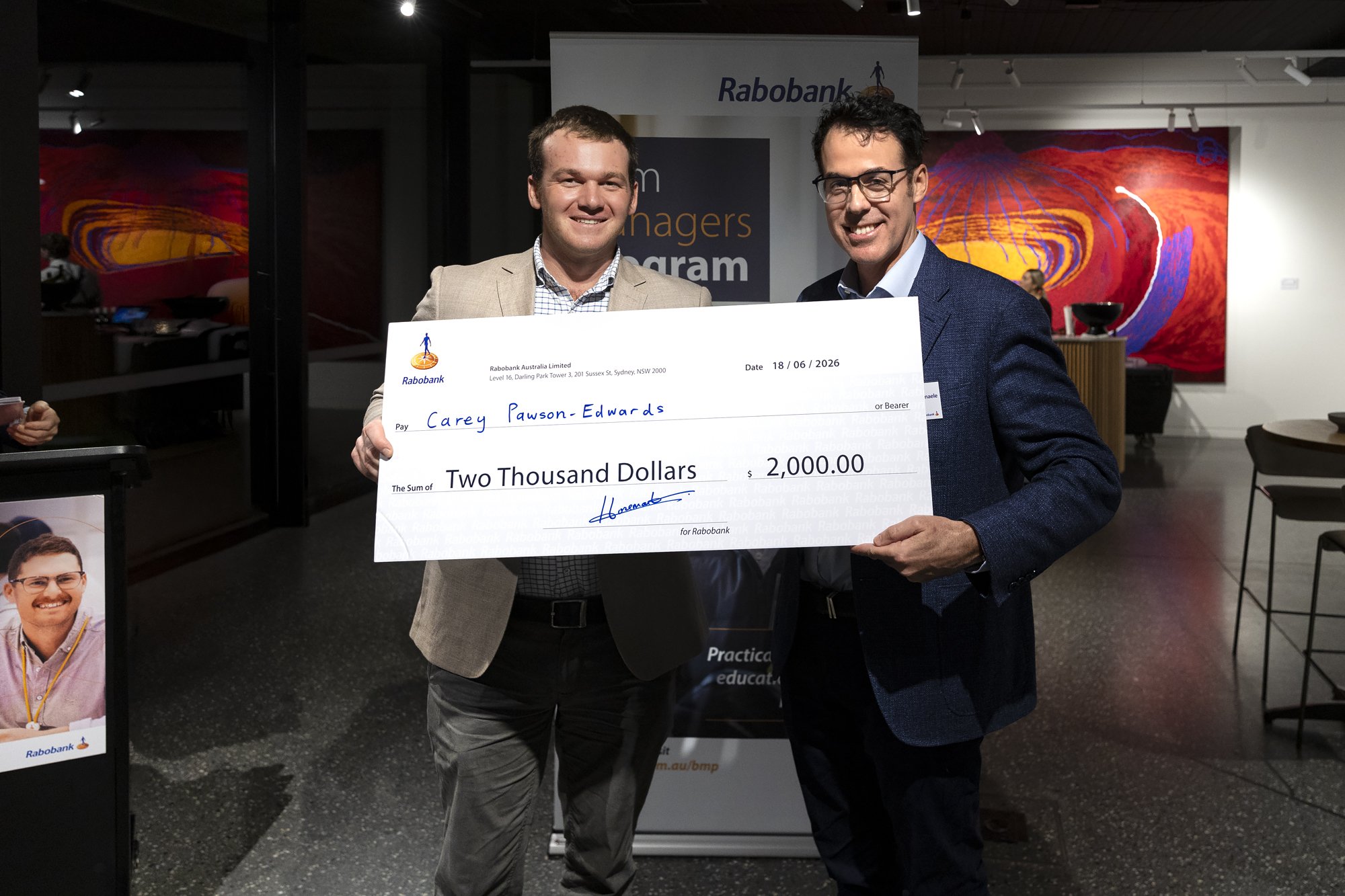
Carey Pawson-Edwards (L) receiving his prize winner’s cheque from Rabobank’s Marcel van Doremaele.
South Canterbury-based Stock Manager Carey Pawson-Edwards has been announced as the winner of the 2026 Rabobank Management Project Award, a business management prize for up-and-coming primary producers across New Zealand and Australia.
Selected from a group of New Zealand’s and Australia’s most progressive farmers – graduates of the 2025 Rabobank Farm Managers Programme (FMP) – Mr Pawson-Edwards was recognised for his business management project, which focused on future proofing the beef system at Caberfeidh Station, a large-scale breeding and finishing property located in the Hakataramea Valley.
Mr Pawson-Edwards was presented with the award at an event in Victoria, Australia on Thursday 18 June attended by participants of the 2026 Rabobank FMP as well as members of the 2025 cohort.
Designed for emerging farmers, the FMP focusses on the development of business management skills, with an emphasis on business planning, leadership, people management and self-awareness.
Caberfeidh Station is one of the six South Island farms that make up Lone Star Farms Limited. The 6000-hectare property winters 32,000 stock units and typically finishes 30,000 lambs and 1,000 cattle per season. Its main enterprises include premium lamb (Lumina), premium Angus beef, bull beef, and wool.
Mr Pawson-Edwards said he’d now been working at Caberfeidh for four years and had forged a career in the agricultural sector despite an urban upbringing.
“I grew up in the centre of Christchurch but, when I was about 12, I spent a bit of time at the farm my uncle worked on in North Otago. I really enjoyed it so then ended up going back there every school holidays afterwards, and that started my connection with the agri sector,” he said.
“After high school, I then spent six years at Coleridge Downs agricultural cadet training programme in the Rakaia Gorge – two years as a cadet and four years as a block manager – before moving on to my current role with Lone Star Farms at Caberfeidh.”
As a stock manager at Caberfeidh, Mr Pawson-Edwards manages a team of nine, ensuring all stock key performance indicators, opportunities and risks are planned and met.
Mr Pawson-Edwards said his management project was developed with the aim of futureproofing Caberfeidh’s beef system and exploring dairy and beef Integration on the farm.
“Lone Star Farms were keen to explore opportunities in this area mid-last year,” he said.
“Normally a farm advisor would do this sort of thing, but Lone Star were happy for me to jump in there and lead the project utilising the skills I’d recently acquired on the FMP.”
Mr Pawson-Edwards said the project responds to emerging cost, environmental and supply chain pressures within a traditional Angus beef finishing system and explores a more efficient and resilient production model.
“It’s focused on evaluating dairy/beef integration as an alternative system, using scenario modelling, greenhouse gas analysis and on-farm trials to compare productivity, profitability and environmental performance,” he said.
“The aim is to transition toward a simplified, lower-risk finishing system that better aligns with the farm’s feed curve, complements our Lumina Lamb Programme, reduces emissions per kilogram of product, strengthens market opportunities for low-carbon beef and positions the business for long-term sustainability.”
Horticulture New Zealand CEO and FMP management project award judge, Kate Scott said Mr Pawson-Edwards’ project demonstrated the real-life value and upskill that comes from participating in the Farm Managers Programme.
“His presentation showed how with a clear idea, data driven analysis and a commitment to driving efficiency that there can be strong profitability gains across the red meat sector,” she said.
Another of the judges, Rabobank Business Management Programmes Director, Dr Robin Stonecash, said what stood out in Mr Pawson-Edward’s project, was his identification of a problem the frameworks provided on the FMP could be used to solve.
“He applied the appropriate tools and came up with an innovative approach to improving efficiency on farm,” she said.
“His project definition was clear, and his presentation was well-structured. It was a pleasure to watch.”
Mr Pawson-Edwards said there were a several components of FMP that had been hugely valuable in the development of his project.
“One of these was a shift in thinking from running a farm day-to-day and getting stuck in an operational head space, to taking a step back and starting to focus on strategy,” he said.
“Another was thinking about our customers and what they are going to want in 10, 20 or 30 years, and not being afraid to change or adapt to align with this.”
“I also came back from the programme thinking that we don’t have to necessarily buy more land or produce more to succeed, and it’s more about creating more value with what we’ve already got.”
Mr Pawson-Edwards said, the FMP had also provided valuable insights which had helped him lead his team through the process of integrating to a new system.
“We did a lot of stuff around personalities on the FMP programme and how to better understand people who work in your team, and that process was really helpful to me in explaining the ‘why’ of the new system and what we’re trying to achieve,” he said.
“I presented the dairy-beef project to the team and, if I hadn’t changed the way I approached and communicated it, I think we would have had quite a bit of push back. But the way I delivered it helped them understand the why and they’re right in behind it now.”
Mr Pawson-Edwards said the FMP also placed a strong emphasis on ensuring participants remain connected after the event.
“I’ve been to a few similar courses, and you meet all these great people, but unless you make an active effort to keep these networks going, they fade away to a certain extent,” he said.
“So, to stop that happening, in conjunction with the bank, I organised a seven-day trip around the South Island earlier this year which was attended by 17 of the participants from last year’s FMP, and included visits to seven different farms as well as showing off some of New Zealand to the Aussies.
“We had a great week, and it’s going to be an annual event now. The Aussies are going to host us next year and we’re going to keep the connections going.”
The annual Rabobank Farm Managers Programme has been run since 2006 and offers farmers from across New Zealand and Australia an opportunity to develop and enhance their business management skills.
Participants leave the course with new skills, techniques and a commercially-driven perspective on farm management. They also gain the ability to put systems and structures in place to manage growth.
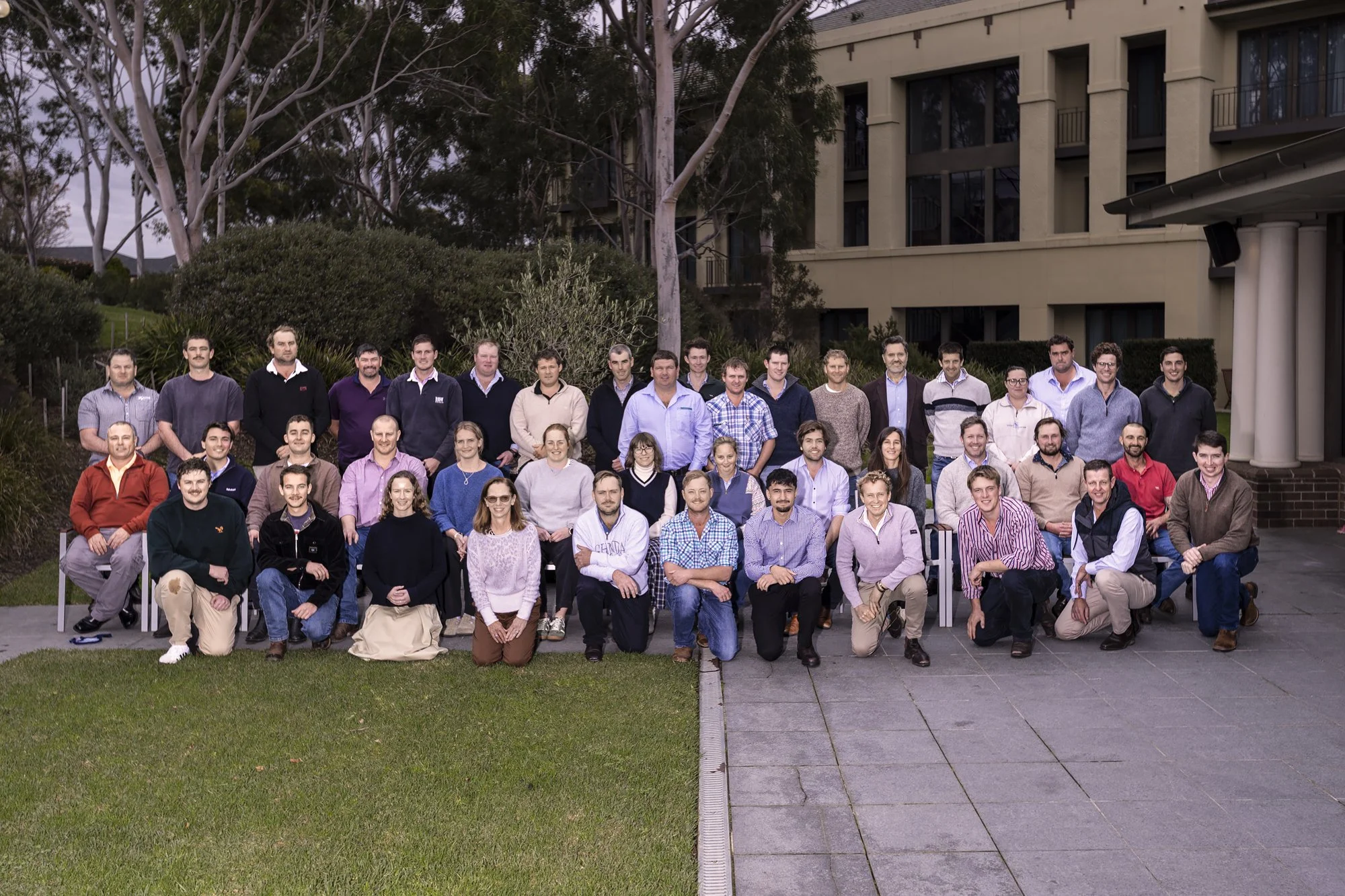
Participants on the 2026 Rabobank Farm Managers Programme which took place in Victoria’s Yarra Valley from 14-19 June.