The price of leadership is being first

By Dianna Malcolm
Phil Empson’s hunger to refine animal welfare on his Waikato property –in among automation and industry firsts –means he is the first in the country to pull the trigger on cutting-edgetechnologies within a mind-blowing new facility at Richmond Downs Ltd, Orakau.
It all began with deciding to install SmartShelters on an unseasonably warm October day, and has ended with another-worldly, plantation-bamboo-clad, 60-bail rotary. The Velocity Cabinet Rotary Milking System includes the first low-profile cabinets to be installed in New Zealand. It also includes a composite dairy platform–like high-performance aircraft and boats –that is 75% lighter and significantly more durable than traditional concrete or steel alternatives. Overlooking the platform is “CaféRD”. This is not just any room. The dairy and this room have been lined with insulated panel roofing, which has 75mm of foam with roofing on top for quietness, insulation,and to keep the temperature down. It features a full star-lit feature wall, using lighting from AM New Technologies, which is part of an overall lighting decision leaning into biological circadian rhythms and activity... But, first things first: what is Phil’s broader “why”for this herd, which is moving to 600 head of spring-calving cows (plus all the young stock) on 200 hectares? “I’m not a follower,” he said. “Someone said to me that I like projects–and I probably do. This is all about animal welfare for me. I was getting the cows in a few years ago and it was 10am, they were already heat stressed, and it was only October. I thought ‘I need to do something’. “If I was going to do it, I wanted to do it once, and I wanted to do it right. Farming is my life and it’s probably the only thing that I know, love and enjoy, so...why not?“ Some people go out and buy a flash car and a boat. For me, I thought why not put that money into the farm, so that the cows enjoy it, the staff enjoy it, and I enjoy it.” That decision unleashed a landslide of automation, new technology and a whole new level of different for this team effort. “I didn’t want ‘just a cowshed’. I wanted something that didn’t look like a tin shed that everyone else seems to have. As farmers, I think we need to up our game. There are two farms that I drive by that I admire, and one has cedar cladding. I didn’t really want cedar, so after I did some homework, I discovered plantation bamboo.” Phil’s builder, Andrew Smith of Te Awamutu Construction (formerly owned by Pat Gibson), said after he got over his surprise, working with plantation bamboo cladding was a positive experience. Andrew said, “Phil found that himself and said he’d like to use it. It’s the first time we’ve used it ourselves. It’s on a clip system, it’s very stable, it doesn’t shrink, and it’s a hardwood product that gives quite a different look. “It wasn’t a challenge, it was more that it was something new, and we believe it’s the first time it’s been used on a cowshed. It is interesting for the aesthetics. “It’s been added to the north and the east faces, because it’s a visual impression for visitors coming in down the tanker track.” But Phil wasn’t finished. He was determined to make this build one for the ages.“I get annoyed with people who ‘pooh pooh’ the dairy industry. There were two main reasons we went this way. We had to grow,and I have a love/hate relationship with technology. I love it, but I hate that I’m always at the pointy end of it because it’s probably the most inefficient area to live.” Loosely translated: Phil isn’t afraid to be first, and that comes with some of the sticky decisions that followers later down the track don’t have to work through.
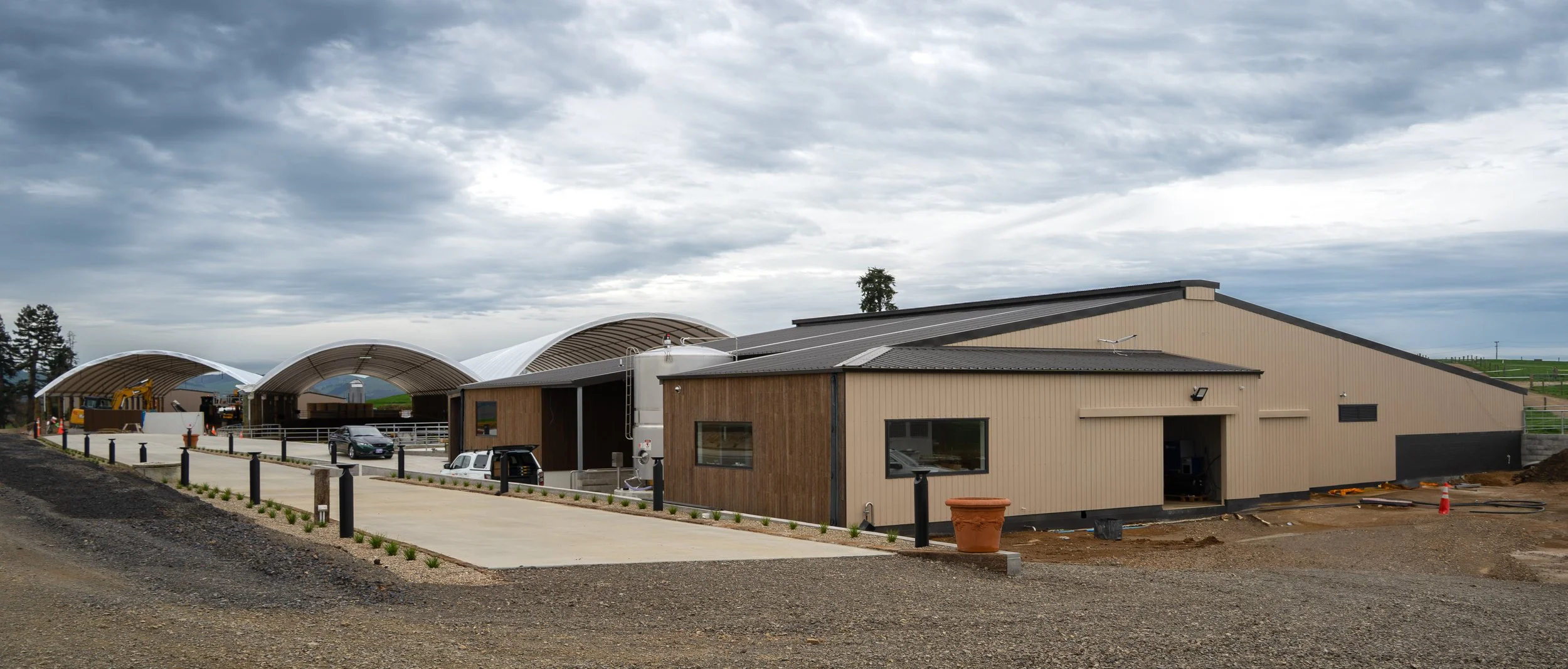
Photo by Dianna Malcolm
Glow wall a feature Café RD overlooks the milking platform and Phil wants it to be a gathering point with a corporate function feel. It has a full kitchen, which means it can cater for guests. “It will be lots of things,” Phil said. “It’s not intended to be open to the public. I’d like it to be a bonding place for the Waikato community by appointment, or a place where you could have a directors meeting, for example.“ There will be a few select people who will have a lifetime membership that can come in and have a coffee anytime–people within the town that have served it well, or that I have an association with.”
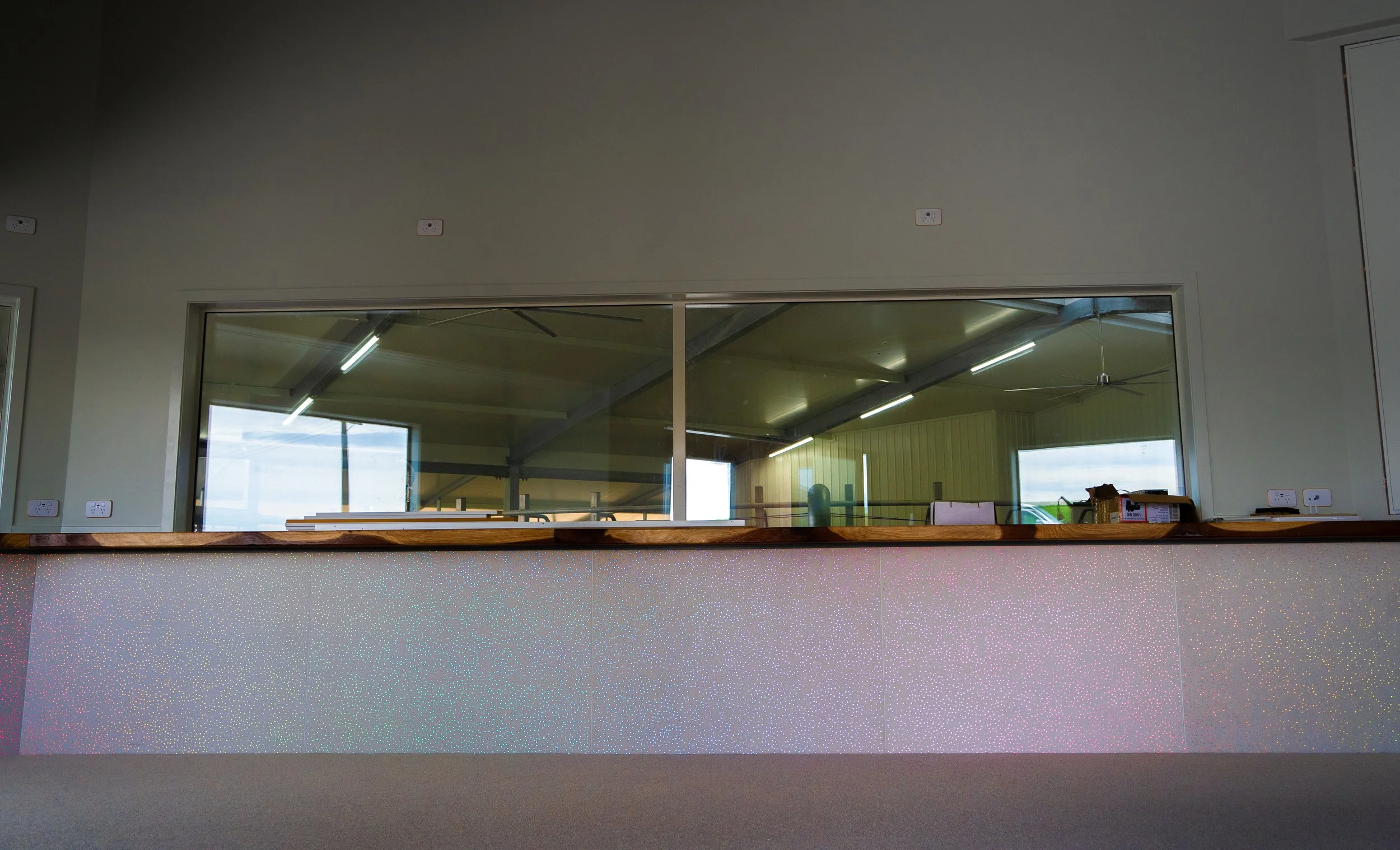
AM New Technologies glow wall -Photo by Dianna Malcolm
“SmartShelters signalled the start”
From the road, the SmartShelters look standard. But think again.They offer the biggest clear spans available within industry (6m to 45m in width times any length]. There are three sheds –two for the cows built in 2023 –which are each 18m wide x 125m long (with some storage space at one end). The calf shed–with some storage, which was built in 2025 and sited alongside them –is 18m wide x 85m long. The cows have four feed faces, which is uncommon and offers efficient feeding on surface area to volume. The space allows 800mm per cow. They have a convenient 6m concrete feed lane for a mixer wagonto drivethrough the centre and deliver feed, and then there is concrete where the cows stand to eat at the feed face (which makes it easy to clean). SmartShelters’ Brett Cottle confirmed that an estimated 70-80% of all manure is dropped where cows eat. Brett said, “We did the design and construction,and what makes this unique is having the mixer wagon lane inside. Most farmers would build two separate structures, but by going this way, Phil has achieved four feed faces –which maximises the feeding opportunities for this herd. He has also included some storage for hay and equipment at one end. He’s pushing for more production and cow comfort, and this certainly addresses that.” The cows are bedded on a compost bedding, which is an active biological mass –rated among the most comfortable natural beddings for cows internationally when it’s well managed. The Richmond Downs’ team “rips” (or aerates)the bedding twice-a-day in the winter, and once-a-day in the summer to sustain its ideal 50-55% moisture level. The SmartShelters were the first stage of this build, which beganin2023.Phil said, “I decided to do that because it gives them shade in the summer and protection in the winter. Every month of the year is different. The cows spend anywhere from two to 20 hours a day in it.“You do need to know what you’re doing with the bedding, but it’s been amazing for us. This whole project is about animal welfare for me. It’s about what can I do for my girls,and, if I was a cow, what would I want?
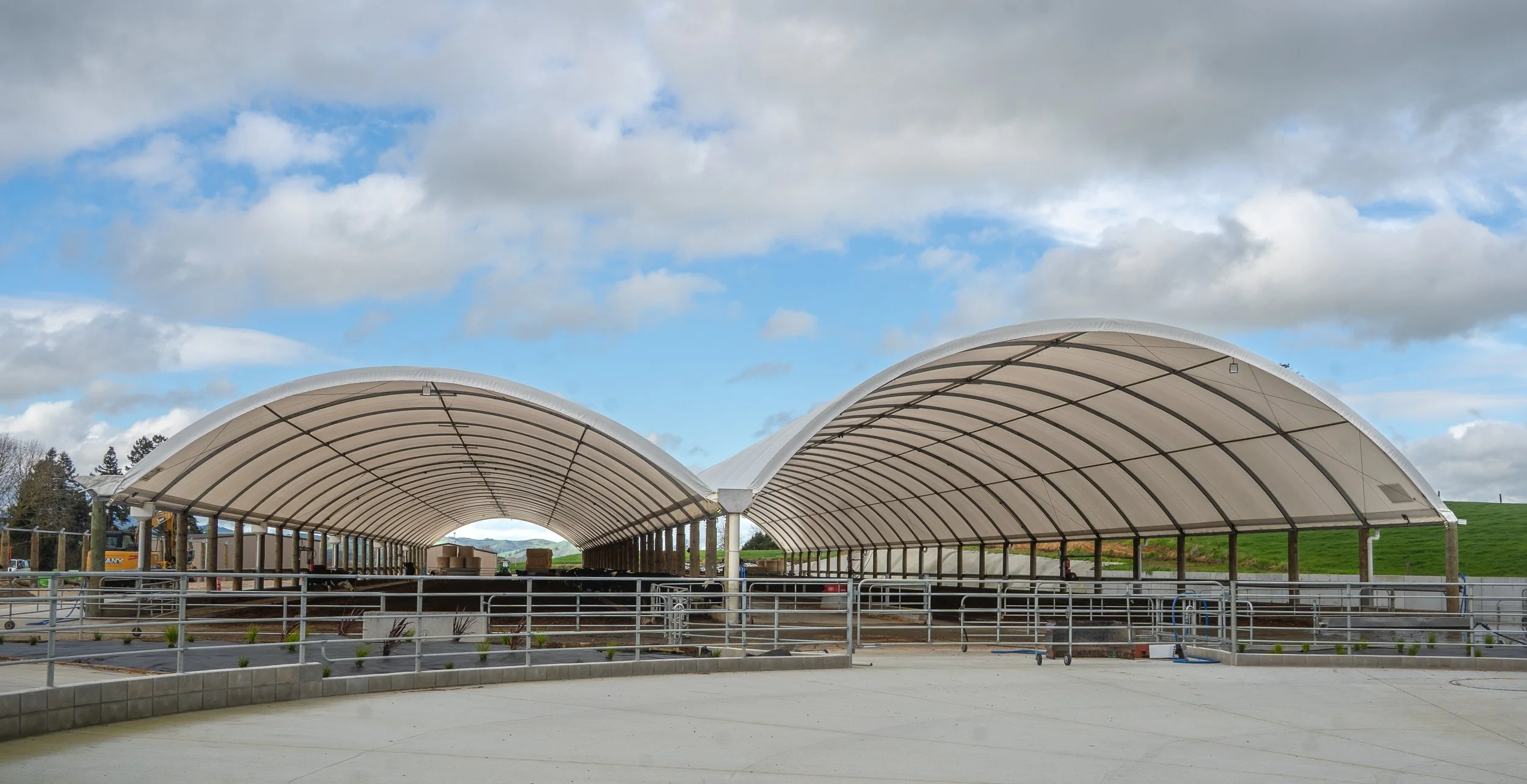
The SmartShelters stand regally at the end of the new yard - Photo by Ella Pirie Photography
“Humans have that variation on how we handle heat. The optimum temperature for a cow is 8-10degrees Celsius, and some people aren’t aware of that. The SmartShelters decision wasn’t all about dollars and cents for me, even though we’re hereto make money.”Cattle brushes have been a huge winner within the SmartShelters.“The cows absolutely adore them. Some cows will come in and go straight to them. They never turn off. They are triggered by motion. If the cow pushes it by more than five degrees, it will turn on. And boy, do they know. When the cows are dry, I swear they never turn off. It’s quite neat watching them. “They will scratch for four or five minutes andthen walk away. Again, it doesn’t create money, but it’s about animal welfare.”
“Dairy doubles down on automation and firsts”
Qubik was responsible for the plant, water, refrigeration, and stainless fabrication, which includes innovative low-profile square bails, with a Waikato system, all running on a composite Velocity Cabinet platform, topped with rubber matting. Qubik has worked with the Empson family for decades –building multiple new dairies. Qubik’s Jason Hare collaborated with Phil to refine his out-of-the-box choices long before this bespoke build became a reality. In amongst a sea of ground-breaking decisions were the square bails and cabinets that house the milking equipment, naturally giving the cows a feeling of space–thanks to a signature low-profile finish. “The square bails happened after I was walking Phil through a factory tour about three years ago,when he was considering his options,” Jason explained. “He spied an export display bail sitting there. He immediately asked about it, and it just went from there. “These are now the first of that design to be installed in this country.” Phil was determined to install stainless steel ... everywhere. The dairy also includes innovative lighting, fans, and insulated roofing panel that is more commonly found in commercial chicken sheds. The insulated panel make this dairy quiet –even when it is pouring with rain outside.Jason said the effort in the front end of the design stages allowed the result. “We do a lot of work with our customers in the lead-up to these builds because there is a tremendous number of choices, and it’s important to make sure we deliver a final result they are excited about,” Jason said. “Phil is also a thoughtful client who likes to push the boundaries, so it’s always interesting to work with him.”Moa Rotary Platforms installedthe composite platform.Moa’s Joe Bradly-Arthur said while the composite platforms are more expensive, they offer significant advantages.
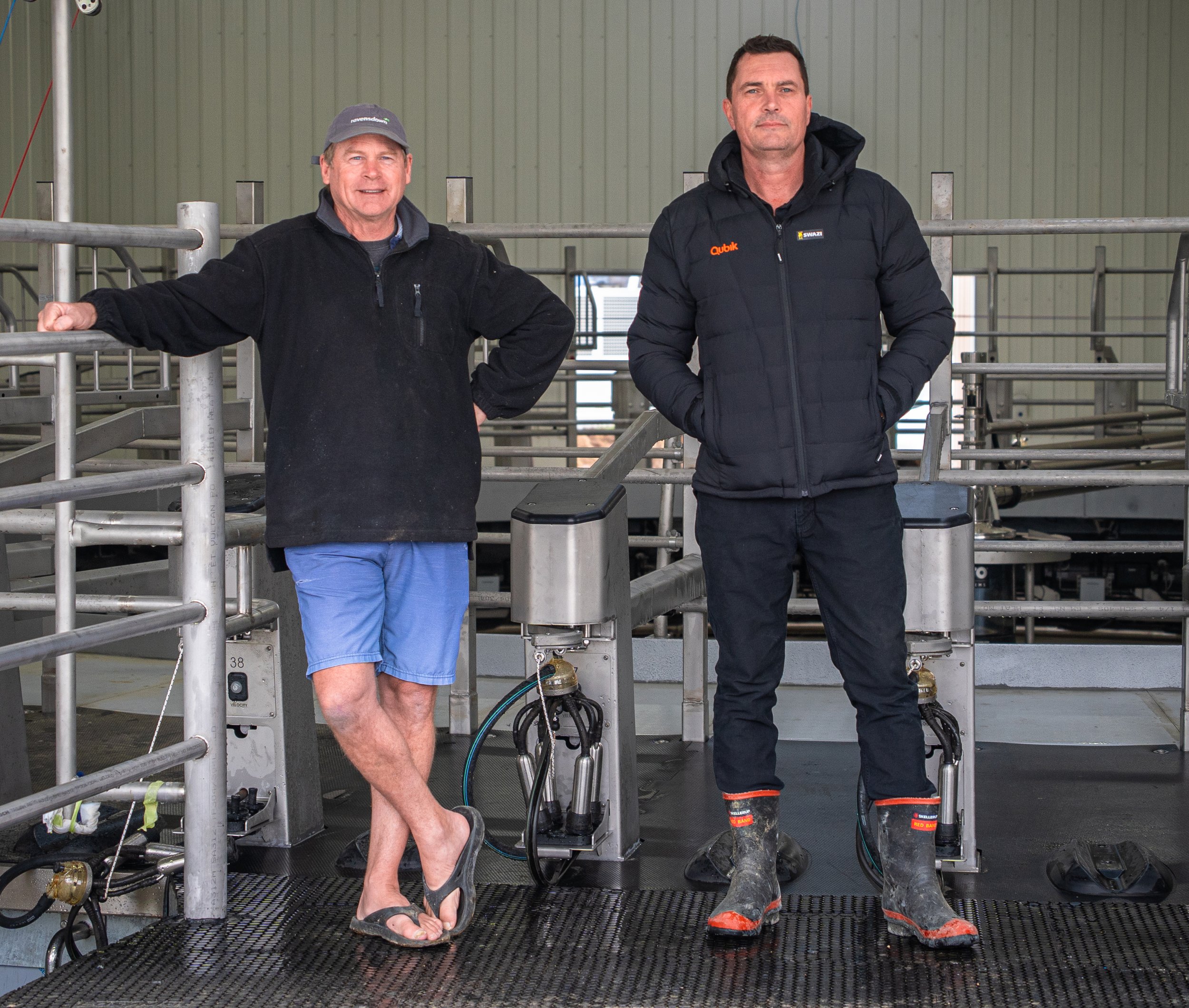
L to R: Phil Empson & Jason Hare - Photo by Dianna Malcolm
“Ultimately, there is less weight on the rollers,” Joe said. “You won’t see the benefit immediately; it’s more about the future savings. Because there is less pressure on the drive motors pulling it around, and that speaks to its lifespan, and you’re using less power day-to-day. It’s also quieter.” Cow collars play a big part in heat detection. They also have Somatic Cell Count detectors, and every cow is herd tested for litres, fat, protein, lactose and milk temperature every milking. They are also weighed every milking.
“Lights are on, somebody’s home”
The lights were designed and installed by AM New Technologies. Phil’s challenge to its National Sales Manager, Bruce Cameron, was to design a light that was automated, smart, and that a bird couldn’t nest on. Bruce also explained the power of Human-Centric Lighting (HCL), which adjusts the colour and intensity of artificial light through the day to match the natural daylight cycle, thus supporting health and well-being by aligning with the body’s natural circadian rhythm. With reports that it can improve production by seven to 10%, Phil was interested.“I like my lights and the technology they bring,” Phil said.“The lights will come on at 5 am automatically, just before milking time. There are lots of things like that. Things you’ll never see, but it all happens.”Phil is the first in New Zealand to install more than 100 Smart Richmond Battens –designed by AM New Technologies’ Jack Johns–which are rated to IP69K. This is the highest current rating on the ingress-protection scale, an international system that rates products based on their ability to withstand the intrusion of dust and water. The birds have no perch, and Phil has full control of them through H3’s smart app. Automated street lighting has also been installed along Phil’s SmartShelters, with solar bollards lighting the pathways. “That’s where those lights came from. There hasn’t been one in the world like that, and I told them what I wanted, and they made it for me, and there it is. To me, that’s a big thing.”
“ A build for the thinkers because there is barely anything run of the mill in this build”
Phil’s builder, Andrew Smith, of Te Awamutu Construction, had to roll with the punches as Phil came up with ideas. “Two years before we started this project I’d spend five nights a week on YouTube, coming up with ideas, stitching them all together, and getting a rough plan,” Phil said. Lining the dairy roof and café with an insulated panel roofing was one of those ideas. It was more expensive,but it gave the structure a quiet, classy finish. Phil explained: “It was something I wanted, because at every cowshed you see the underside of tin. We are at least 6-8 degrees cooler in here with this. “I went and looked at chook houses that had this roofing panel and thought ‘yep, that’s what we’ll do’, and that’s what we did.
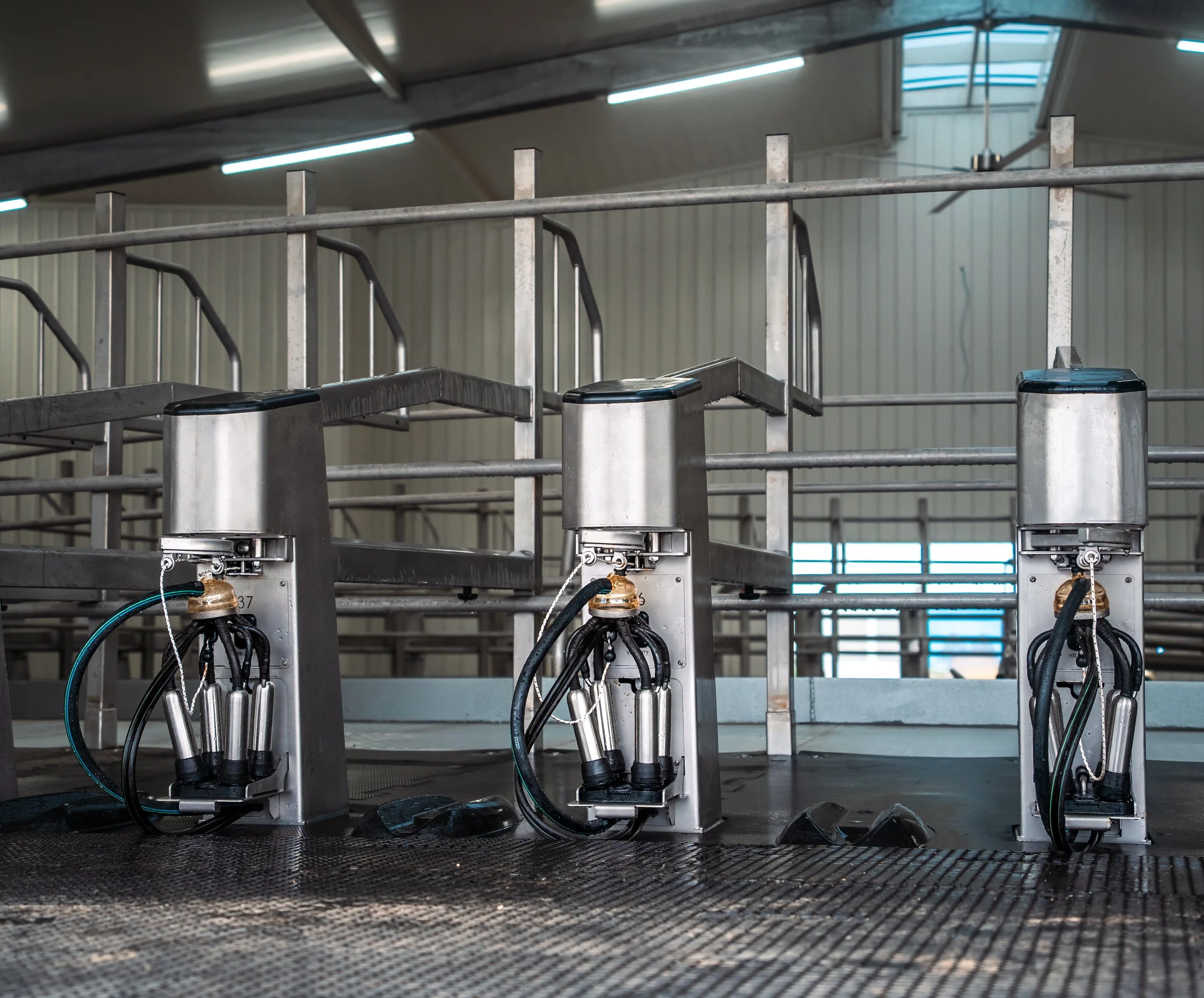
The Qubik milking plant and Moa platform - Photo by Dianna Malcolm
“It’s expensive, but you can be here in a rainstorm,and we can have a conversation. Tin is very noisy and hot. This is good for cows,and it’s good for us.” Andrew admitted he had to be always ready. “When everyone disappeared, I would come down here and spend time and consider things,” Phil said. “Like the window in the café. I realised that the lateral window was going to be too small. So, we pushed that room out and aligned it with the building. “It has really opened up the room and the tall ceiling and open plan gives the feeling of more space.” Consciously subtle Phil chose TechniPharm’s The HoofCare Handler™ crush.“I went to the fielddays and started looking at my options. That was their best crush, and it had all the hydraulics and no manual things where people could break their arm or lose fingers. It was a health and safety decision for me,” Phil said. Phil said Empire Concrete Pumping had pumped concrete onto some walls behind the SmartShelters, which has effectively cemented the walls’ position. The next project is to turn the old dairy into a calf-rearing facility. The milk will be pumped across, and it will operate as a stand-alone operation. Phil says, “I like simple. I like efficient. This ticks that box for me.“ There are lots of things that are not obvious in this build, because I wanted a minimalistic look. “But they are there.“ That has been a big challenge for the whole project because people aren’t used to thinking of things they haven’t had to think of before. “For me, that was one of the primary objectives, but it was probably the most difficult to achieve.
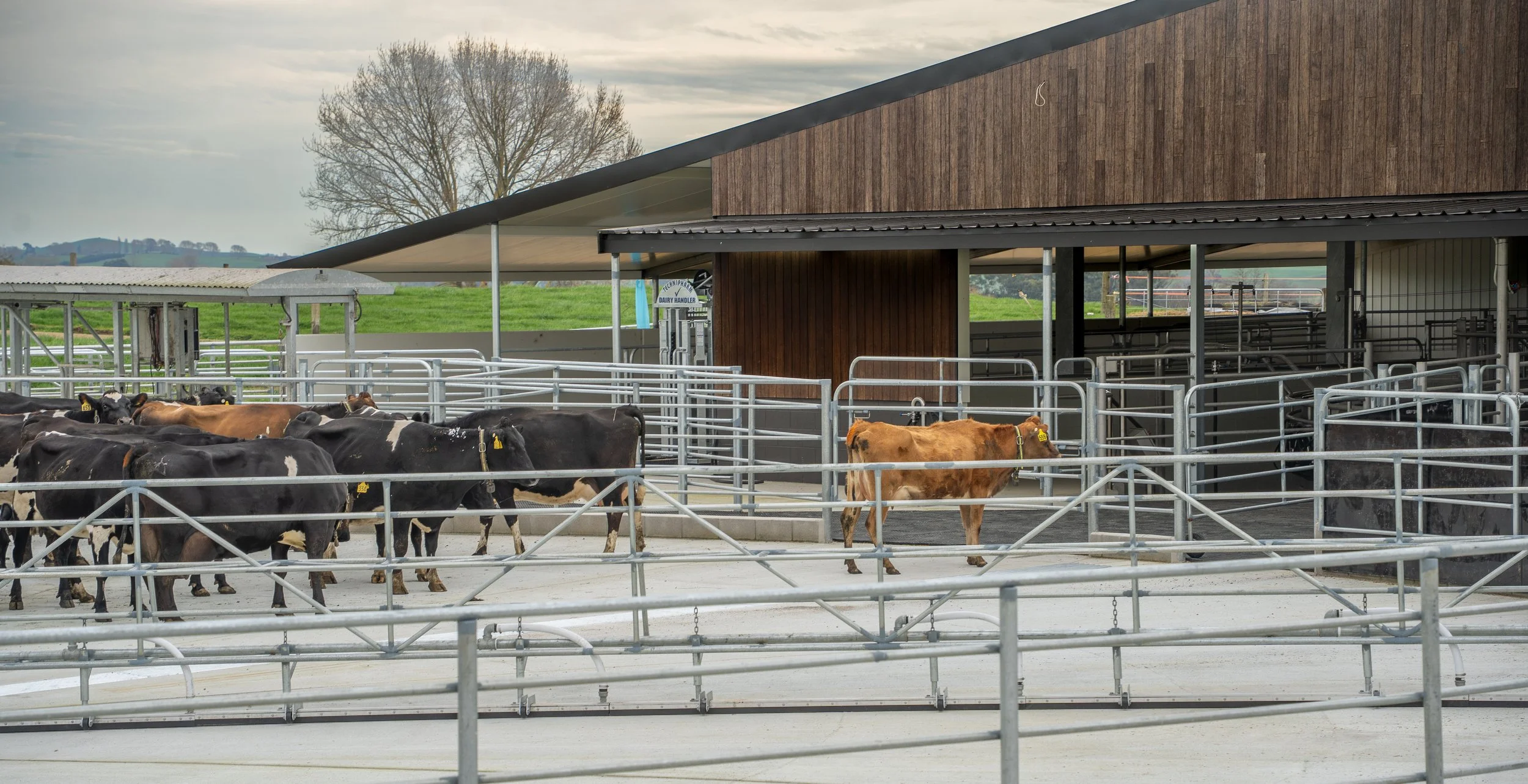
The new dairy shed showing the robust plantation bamboo cladding - Photo by Dianna Malcolm