
There are few pieces of farm equipment more ordinary than a gate. It does not have an engine, a computer, a hydraulic system or a warning light. It does not appear particularly clever. Most farmers could probably explain its basic purpose to a child in about five seconds: it opens when you want to get through and closes when you want to keep something in.
Yet the humble farm gate is actually a rather good example of agricultural engineering. It has evolved around livestock behaviour, available materials, working habits, terrain, machinery and the simple requirement that a farmer should be able to open and close it without making a complete production of it. In New Zealand, generations of farmers have adapted gate designs to suit everything from sheep stations to dairy farms, often with a healthy dose of practical improvisation thrown into the mix.
The result is that a gate is rarely just a gate. Look closely and there is quite a story behind why it looks the way it does.
From hurdles to hinged gates
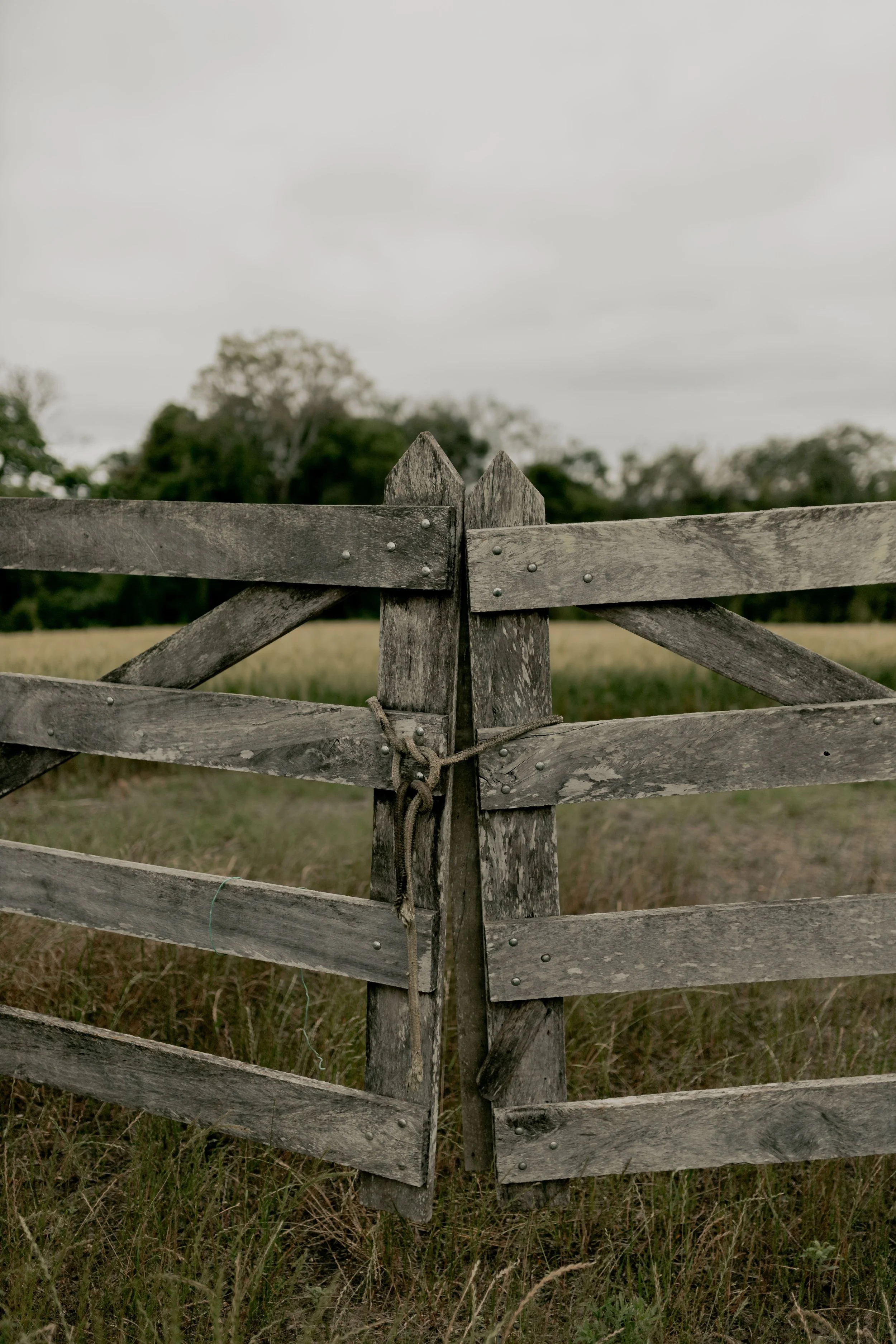
The earliest European farm gates in New Zealand were not necessarily the neat galvanised structures we picture today. Gates developed from much simpler barriers, including wooden hurdles that had been used to make temporary pens for sheep. As farms became more established and particular gateways were used repeatedly, more substantial wooden gates were built and hung on hinges. That basic arrangement proved remarkably successful because it solved the fundamental problem without making the farmer reinvent the wheel every time stock needed moving.
The principle has barely changed. A gate occupies an opening in a fence but needs to become a fence again when it is closed. It therefore has to be strong enough to withstand stock pressure, light enough to operate, attached securely enough to survive years of use and positioned so that it does not interfere with everything else happening around it. Modern farm gates may be made from galvanised steel pipe, wire mesh or other manufactured materials, but underneath the modern appearance is an idea that is centuries old: make the barrier movable when access is required and solid when it is not.
New Zealand had to make do
New Zealand farming has always had a strong relationship with making use of what was available. Early fencing varied according to the landscape and materials at hand. Timber was plentiful in some areas, while other parts of the country made greater use of wire as it became available. The rise of wire fencing transformed farming because it was relatively cheap, lightweight and quick to construct, allowing much larger areas of land to be divided and managed.
That change naturally affected gates. A substantial wooden fence needs a substantial wooden gate, while a lightweight wire fence does not necessarily need an elaborate barrier. The gate has to fit the job and the fence it belongs to.
Then there is the uniquely New Zealand invention, or at least uniquely New Zealand association, of the Taranaki gate. Traditionally made from several lengths of plain wire with battens and sometimes barbed wire, it was very much a product of practicality and limited resources. It could be constructed from materials already available around the farm and did not require a conventional hinged gate frame. Despite its name, there is no firm evidence that it actually originated in Taranaki, which seems almost unfair to Taranaki given how firmly the name has stuck.
Why does a gate swing?
The swinging gate is such a familiar sight that we rarely stop to ask why it became the standard arrangement. The answer is partly about simplicity.
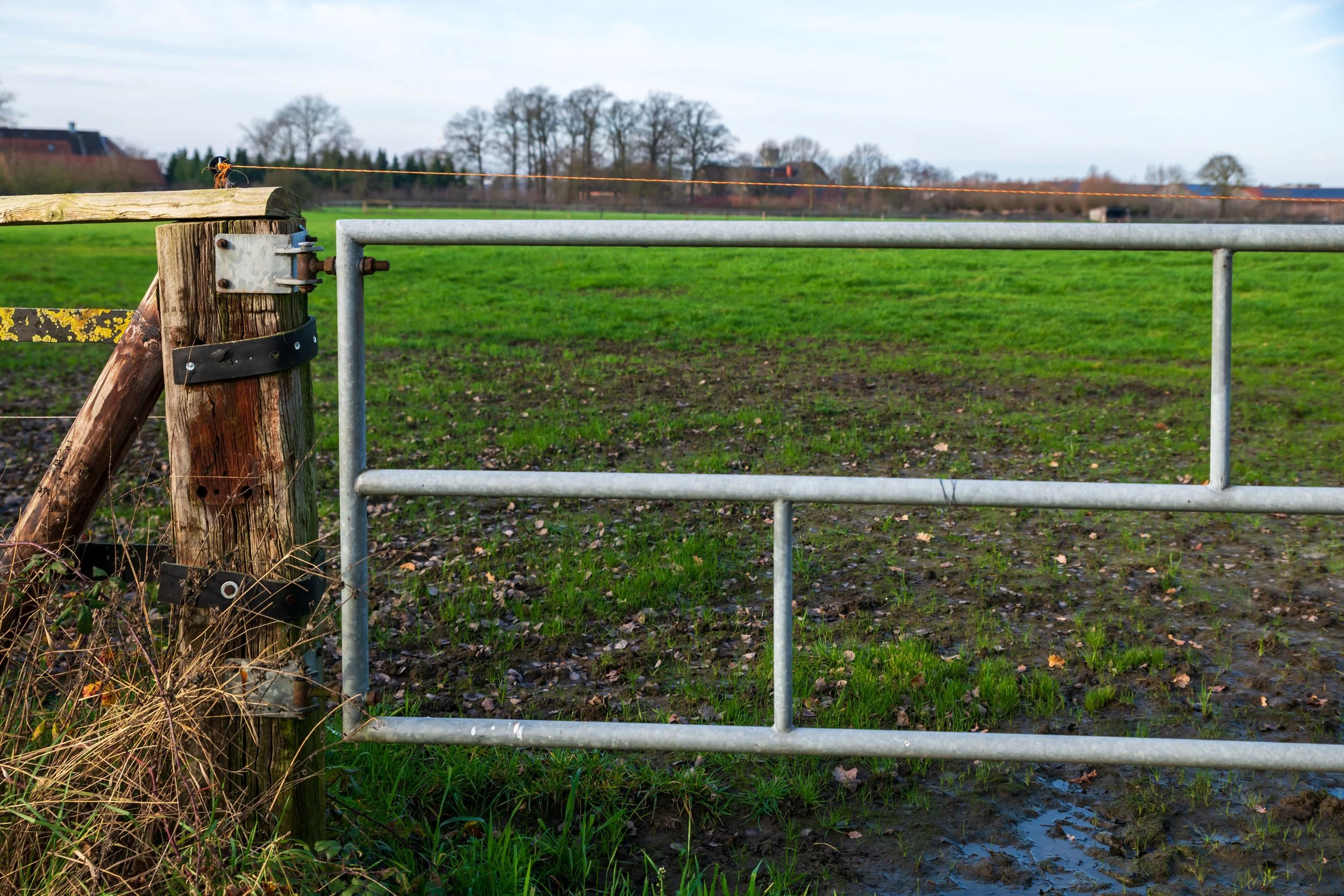
A hinged gate turns around a fixed point, meaning the farmer only needs to move it through an arc rather than lift the whole thing away from the opening. The hinges carry the weight while allowing the gate to become a barrier or an opening as required. It is a beautifully simple piece of engineering.
But the direction and space available for that swing matter enormously.
A gate cannot swing through a fence post, a trough, a building or a parked vehicle. It needs somewhere to go. This is why farmers can become remarkably particular about which way a gate opens. The preferred direction is often determined by how stock move through the gateway, where people are standing, where machinery needs to travel and whether the gate can be secured safely when open.
A badly positioned gate can turn a simple job into an irritating wrestling match. A well-positioned one can be opened almost without thinking.
That is good farm engineering: the machinery disappears into the background because it works.
Why cattle gates are built differently
A cow is not a sheep with extra legs, and a gate designed to contain one should not necessarily be treated as a larger version of a sheep gate.
Cattle are heavier, stronger and capable of putting considerable physical pressure against fencing and gates. They can lean on a barrier, rub against it, push it and test anything that looks as though it might move. Consequently, cattle fencing and gates generally need to be more substantial than those intended primarily for sheep.
New Zealand's farming history reflects this difference. Te Ara notes that cattle fencing traditionally tended to be heavier, with wooden posts and battens, because cattle could do more damage than sheep. Sheep fencing, particularly on South Island stations, made much greater use of wire.
The same principle carries through into gate design. A cattle gate needs to cope with a different sort of animal pressure. Its height, strength, construction and fittings all need to reflect the animals it is expected to contain.
A sheep gate, by comparison, is designed around a much smaller animal that behaves differently around barriers. The gaps, height and construction can therefore be different.
It is not simply a matter of making one gate stronger than another. The animal itself is part of the engineering equation.

Photo by Dianna Malcolm
The gaps are not accidental
Look at a traditional stock gate and the spaces between the rails or wires may appear fairly ordinary. But those gaps are doing a job.
A gate needs to create a barrier without necessarily becoming a solid wall. Open construction reduces weight, allows the farmer to see through it and can make the gate easier to handle. At the same time, the spacing needs to be appropriate for the livestock being contained.
A sheep should not be able to squeeze through a gap intended for something larger, while a calf can present an entirely different challenge from an adult cow. Anyone who has watched a determined young animal investigate a fence will know that livestock are perfectly capable of finding the one weakness the person who built the fence forgot about.
Gate design therefore has to consider not only the adult animal but the smallest and most inventive animal likely to encounter it.
When space became the problem
The ordinary swinging gate is wonderfully simple, but it has one obvious weakness: it needs space to swing.
That is not always convenient, particularly inside yards and woolsheds where people, stock and gates may all be trying to occupy the same small area. This is where alternative designs began to appear.
New Zealand agricultural publications from the middle of the twentieth century documented swing gates alongside lift-up, slide-back and tip-up designs for sheep yards. A lift-up gate could be moved vertically, saving lateral space, while a slide-back gate could disappear alongside or into the fence. These designs were not simply inventions for the sake of being different. They addressed practical problems created by crowded working spaces and animals pressing against gates.
There was even a lift-swing gate design for woolsheds that combined the two movements, allowing the gate to be lifted and swung over sheep before being lowered into position. It sounds wonderfully complicated until you consider the problem it was designed to solve: getting a gate out of the way without requiring a huge amount of floor space.
Farmers have never been short of inventive ways to make a gate behave.
Why some gates lift instead of swing
A lift gate is a particularly clever solution when horizontal space is scarce. Instead of requiring a wide arc, the gate moves upwards.
The idea has another advantage in a busy stockyard. A swinging gate can be pushed against by animals, making it difficult for someone to move. A properly designed lift gate can be less vulnerable to that particular problem because the direction of movement is different.
Of course, nothing on a farm is ever entirely free of compromise. A lift gate requires suitable guides, enough clearance above it and some way of supporting its weight. Historical designs even used counterweights and pulleys to make heavy gates easier to operate.
It is a lovely example of agricultural engineering being driven by a very simple question: how do we move this thing without fighting it?
The magic of the hinge
The humble hinge deserves more credit than it usually receives.
A gate can weigh a considerable amount, yet a good hinge arrangement allows a person to move it with surprisingly little effort. The hinge transfers the load into the gate post while allowing rotation around a fixed point.
That post is therefore much more important than it looks. A heavy wooden gate needs something substantial to hang from because the weight is effectively being carried at the edge of the opening. Over time, the constant movement of the gate puts forces through the hinges and post.
This is why an old wooden gate can become increasingly difficult to operate when the supporting post begins to lean. The gate itself may still be perfectly sound, but its carefully balanced geometry has been altered.
Suddenly the farmer is lifting, dragging and swearing at something that worked perfectly well ten years earlier.
The gate has not necessarily become heavier. The engineering around it has changed.
The latch has a job too
Then there is the humble latch, another piece of farm hardware that rarely receives the recognition it deserves.
A latch needs to keep the gate closed but also needs to be simple enough that a farmer can operate it quickly, sometimes from a vehicle, on foot, in gloves or while trying to keep several cows moving in the desired direction.
That is why farm gate hardware tends to favour practicality over elegance. A beautiful latch that requires two hands and a degree in mechanical engineering is unlikely to win many friends on a dairy farm.
The best gate hardware tends to be obvious. You approach it, your hand knows what to do and the gate opens.
That apparent simplicity is actually the result of good design.
The gate became part of the machinery
As farming became increasingly mechanised, gates had another problem to solve. They were no longer being opened only by people walking between paddocks. Tractors, trucks, bikes, utes and other machinery needed to pass through them.
That changed the requirements.
A gate might need to provide a wide enough opening for a tractor while still being suitable for livestock. It might need to be positioned so machinery can approach without a difficult turn. It might be used dozens of times during a busy day, making the ease of opening and closing increasingly important.
The arrival of the motor vehicle also contributed to the development of another very New Zealand rural feature: the cattle stop. Instead of opening a gate every time a vehicle needed to cross a boundary, a cattle stop allowed vehicles to pass while livestock were generally discouraged from doing the same. In parts of Otago and Southland, cattle stops became known as motor gates.
It is another example of the farm gate problem being solved by deciding that perhaps the gate did not need to be opened at all.
The gate that was built on the farm
Not every farm gate came from a catalogue or rural merchant. For generations, farmers and local tradespeople built gates themselves.
A 1939 article in the New Zealand Journal of Agriculture described home-made farm gates in considerable practical detail, including timber dimensions, methods of attaching wire and ways of arranging the framing to provide strength against horizontal pressure from livestock. The article made the point that a useful farm gate did not necessarily need to be expensive and could be constructed by a reasonably handy person.
That attitude still feels very familiar.
A farmer sees a problem. There is some timber in the shed, a bit of wire, a welder, a grinder and perhaps a gate that has already been repaired twice. A solution emerges.
It may not look like anything in a design manual, but if it works for the next twenty years, it has earned its place.
There is no single perfect gate
Perhaps the most interesting thing about farm gates is that there has never been one design that suits every farm.
A sheep station in the South Island has different requirements from a North Island dairy farm. A woolshed has different requirements from a paddock entrance. A gateway beside a public road has different considerations from one between two grazing blocks. A narrow laneway needs something different from a machinery entrance.
The landscape matters too.
So does the livestock.
So does the person who has to use the gate.
This explains why New Zealand farms have such a mixture of traditional wooden gates, steel stock gates, wire gates, Taranaki gates, yard gates, sliding gates, lift gates and all manner of custom-built variations.
Agricultural design is rarely about making something look clever. It is about making something work.
The remarkable thing about an ordinary gate
The farm gate may be one of the least celebrated examples of engineering on a dairy farm, yet it solves a remarkably complicated problem.
It needs to control movement without becoming an obstacle. It needs to contain livestock without unnecessarily restricting people and machinery. It needs to be strong without being impossibly heavy. It needs to survive weather, mud, stock pressure and thousands of openings. It needs to be simple enough that someone can operate it while half awake on a cold winter morning.
And, preferably, it needs to keep doing all of that for years.
The next time you walk through a farm gate, it is worth giving it a second look. Notice which way it swings. Look at the hinges, the post, the latch and the spacing between the rails. Think about why it is that height and why it is that width. Consider whether it was designed for sheep, cattle, machinery or all three.
There is a surprising amount of thought hiding in those ordinary pieces of steel and timber.
New Zealand farming has always been good at practical invention. From early wooden barriers and hurdle-style gates to wire fencing, Taranaki gates, cattle stops and increasingly sophisticated yard systems, the humble gateway has continually adapted to the way farms and farmers have changed.
And perhaps that is why the farm gate has survived so well. It does not need to be fashionable. It just needs to work.
Open it. Move through. Close it.
Then do it again, perhaps twenty or thirty times before the day is over.
For something so ordinary, the humble farm gate has had quite an engineering career.