
Welcome to Day 2 of our seven-day series, Masterclass in pasture & feed management, and today we are looking at the habits that sit behind consistently good pasture management.
Yesterday we looked at the feed wedge and how it provides a picture of what is happening across the farm. But having that information is only half the job. The real value comes from what the farmer does with it.
Good pasture management is rarely about one clever decision or a secret formula. It is usually the result of a series of simple things being done consistently, season after season. The best pasture managers tend to know what is happening across their farm because they have developed routines that keep them close to the grass.
They walk. They measure. They watch. They adjust.
And they do not wait until the cows are standing at the gate looking hungry before deciding there is a feed problem.
Habit one: Walk the farm regularly
It sounds almost too simple, but regular farm walks are one of the most useful tools available to a pasture manager.
Looking at the farm from the quad bike, tractor cab or farm vehicle gives you a general impression, but walking paddocks gives you a very different perspective. You can see pasture density, species composition, weeds, damage, pugging, uneven growth and changes in pasture quality that can easily be missed when travelling past at speed.
A regular walk also builds familiarity with the farm. Over time, you begin to recognise which paddocks are consistently strong, which ones struggle and how different areas respond to changes in weather and grazing pressure.
That knowledge is valuable because every farm has its own personality.
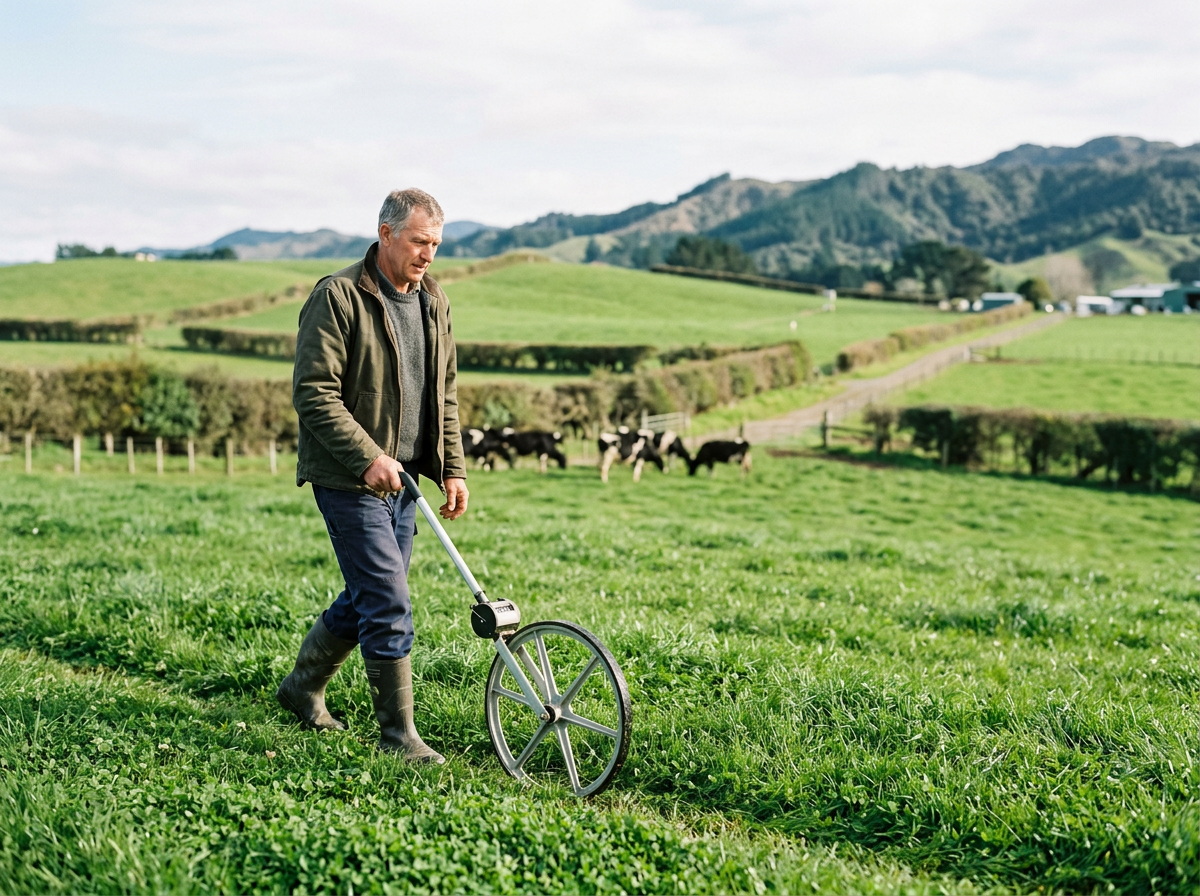
Habit two: Measure rather than guess
Experienced farmers can often make a surprisingly good estimate of pasture cover simply by looking at it, but measurement provides another level of confidence.
The purpose is not to turn pasture management into an endless numbers exercise. It is to give the farmer a reliable indication of what is actually available and how the farm is changing.
When measurements are taken regularly, trends become easier to spot. Average pasture cover may be rising, falling or holding steady. Individual paddocks may be moving differently from the rest of the farm. The grazing rotation may be getting ahead of growth or beginning to catch up with it.
That information can then feed directly into grazing decisions.
The more consistently pasture is measured, the more useful the information becomes.
“Good pasture management is less about knowing exactly what the grass is doing today and more about recognising where it is heading.”
Habit three: Know your target pasture cover
Pasture management becomes much easier when there is a clear target to work towards.
The appropriate pasture cover will depend on the farm system, time of year, grazing strategy and herd requirements. There is no single number that works perfectly for every property, but having a defined target gives the farmer something against which to measure what is actually happening.
The key is to avoid treating the target as a rigid number that must be achieved regardless of circumstances.
Weather can change the game quickly. Growth rates can surge after rain, slow during a dry spell or vary considerably between paddocks. A target should therefore be used as a management guide rather than a number that dictates every decision.
The important question is whether the pasture supply is sitting in the right zone for the farm's current grazing plan.
Habit four: Watch the rotation, not just the paddock
It is easy to become focused on the paddock the cows are grazing today.
Good pasture managers are also thinking about the paddocks the cows will be grazing next week and the week after that.
The grazing rotation provides a useful way of connecting today's pasture cover with future feed supply. If the rotation is lengthening because grass growth is strong, that may be a positive sign. If it is being shortened because pasture is running out, the farmer needs to understand why.
A rotation that looks comfortable today can become very uncomfortable surprisingly quickly when growth slows.
That is why looking ahead matters.
The question is not simply whether there is enough grass in front of the herd right now. It is whether there will be enough grass when the herd reaches the next group of paddocks.
Habit five: Adjust early
One of the defining habits of strong pasture managers is the willingness to make small adjustments before they become big ones.
If pasture growth is slowing, there may be several options available. The grazing rotation can be adjusted, demand can be managed, supplementary feed can be introduced or decisions can be made about which paddocks should be protected for future use.
Likewise, when growth accelerates, there is an opportunity to capture surplus rather than allowing pasture quality to deteriorate.
Waiting tends to make decisions harder.
If a farmer waits until the cows are already short of grass, there are fewer options available and the decisions become more expensive. Acting while there is still some flexibility allows the farmer to choose the response rather than simply reacting to the problem.
Good pasture management is therefore often about timing.
Habit six: Know what the cows are telling you
The pasture may look good on paper, but the cows provide another important piece of information.
Cow behaviour, grazing time, milk production, body condition and general performance can all provide clues about whether the grazing programme is delivering what is required.
If cows are consistently cleaning up paddocks extremely quickly and looking for more feed, that may prompt a closer look at pasture allocation and available dry matter. If cows are leaving excessive pasture behind, the grazing plan may also need reconsidering.
The cows are not a pasture measuring instrument, but they are certainly part of the feedback system.
A good pasture manager looks at the grass and then looks at the cows.
Habit seven: Keep learning from the farm
Perhaps the most useful habit of all is paying attention to what happened last time.
Every season provides information.
A paddock that failed during a dry summer may need a different management approach next time. A block that produced an unexpected amount of spring feed may be worth monitoring more closely. A grazing decision that worked particularly well can become part of the farm's future strategy.
Over several seasons, these observations build into something extremely valuable: farm-specific knowledge.
No two farms respond in exactly the same way. Soil types differ, pasture species differ, rainfall differs and grazing systems differ. Learning how your own farm responds is therefore just as important as understanding general pasture principles.
Consistency beats cleverness
There is often a temptation to look for the latest pasture-management trick, but good results are usually built on consistency.
Walking the farm once does not make someone a good pasture manager. Measuring pasture for three weeks and then abandoning it does not create a useful trend. Having a grazing plan that is ignored whenever things get busy is not much of a plan.
The habits have to become part of the farming routine.
That is what makes them powerful.
The farmer who regularly walks the farm, measures pasture, checks the rotation, watches the cows and makes timely adjustments is continually building a better understanding of the feed system.
And that understanding becomes particularly valuable when the season does not go according to plan.
When the weather changes the rules
Pasture management is relatively straightforward when grass growth is predictable.
Unfortunately, farming rarely offers that luxury.
A wet spring, a sudden dry spell, an unusually cold period or a burst of warm weather can all change pasture growth. Strong pasture managers recognise that the plan is not something that gets written once and then followed blindly for the rest of the season.
It is a working plan.
When conditions change, the grazing strategy may need to change with them.
That might mean protecting pasture for later, bringing silage into the system, changing the rotation or making decisions about surplus. The important thing is that the farmer sees the change coming and responds before the feed position becomes critical.
The pasture manager's mindset
The difference between simply grazing cows and actively managing pasture often comes down to mindset.
A passive approach asks, “How much grass have I got?”
A proactive approach asks, “What is growing, what is being eaten, what is coming next and what do I need to do now?”
That second approach turns pasture into a managed feed resource rather than something that simply happens in the paddock.
It also helps take some of the pressure out of seasonal decision-making. When the farmer has regular information, clear targets and established routines, decisions do not have to be made from scratch every time conditions change.
The seven habits of strong pasture management are not complicated. Walk the farm regularly, measure pasture, know your target cover, watch the rotation, make adjustments early, listen to what the cows are telling you and learn from what the farm does each season.
None of these habits is particularly glamorous, but together they can make a substantial difference to how effectively grazed grass is converted into milk.
The cheapest feed on the farm is only cheap when it is grown well and harvested efficiently by the cow. The farmer's job is to make sure the grass is there at the right time, in the right quantity and at the right stage of growth.
That takes observation, discipline and a willingness to stay one step ahead.
See you tomorrow for Day 3 of our Masterclass in pasture & feed management, when we tackle one of the perennial challenges of dairy farming – plugging the summer feed gap without compromising the season ahead.